
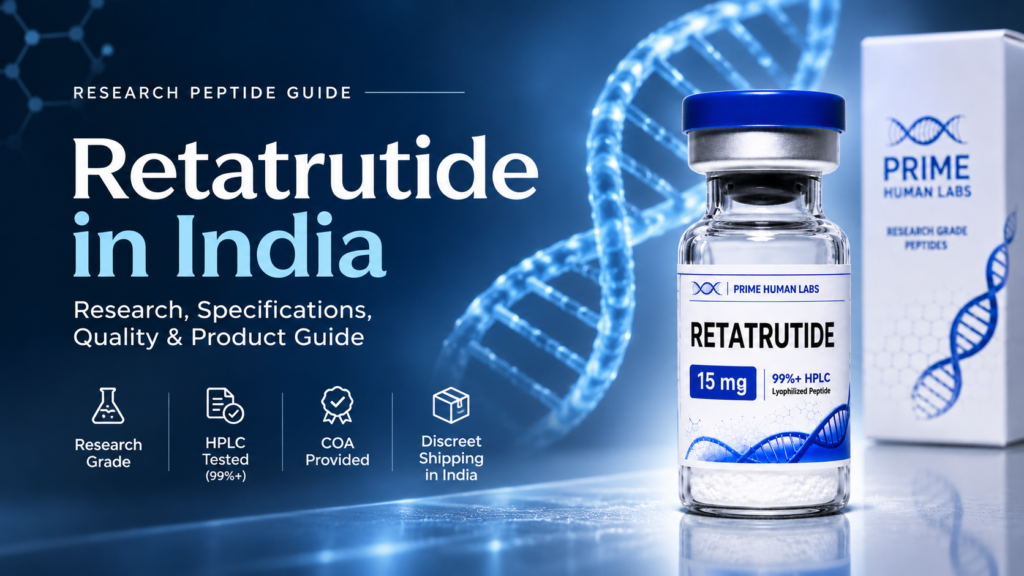
Retatrutide is attracting significant attention in metabolic research. Searches for Retatrutide India and Reta India have increased as researchers seek information about its molecular properties, clinical development, analytical testing and product documentation.
Developed by Eli Lilly, retatrutide is an investigational triple hormone receptor agonist that targets GIP, GLP-1 and glucagon receptors.
For laboratories and research professionals, understanding the molecule is only one part of the process. Documentation, analytical methods, batch traceability and regulatory status are equally important.
This guide explains the science behind retatrutide, what to examine in research product documentation and how to interpret available quality information.
Research-use disclaimer: Retatrutide remains investigational and is not approved for general human use. This article does not recommend its purchase, administration or use for weight management or any medical condition.
Table of Contents
What Is Retatrutide?
Retatrutide, also known by its development code LY3437943, is an investigational peptide-based molecule developed by Eli Lilly.
It is classified as a triple hormone receptor agonist because it activates three different receptors:
- GIP receptor
- GLP-1 receptor
- Glucagon receptor
These pathways are involved in metabolic regulation, glucose signalling and energy balance.
Its triple-receptor activity makes retatrutide an important subject in ongoing metabolic research.
Why Is Retatrutide Receiving Attention?
Retatrutide has progressed through multiple stages of clinical development, including Phase 3 trials.
In May 2026, Lilly announced positive results from its TRIUMPH-1 Phase 3 trial. The company reported substantial average weight reductions in the study population over 80 weeks.
These findings have increased scientific interest in the molecule. However, clinical trial outcomes should not be interpreted as guarantees of individual results or evidence that an investigational product is suitable for human use.
Researchers should consult the complete published clinical data and evaluate the study methodology, endpoints, limitations and adverse-event information.
Understanding Retatrutide Research Specifications
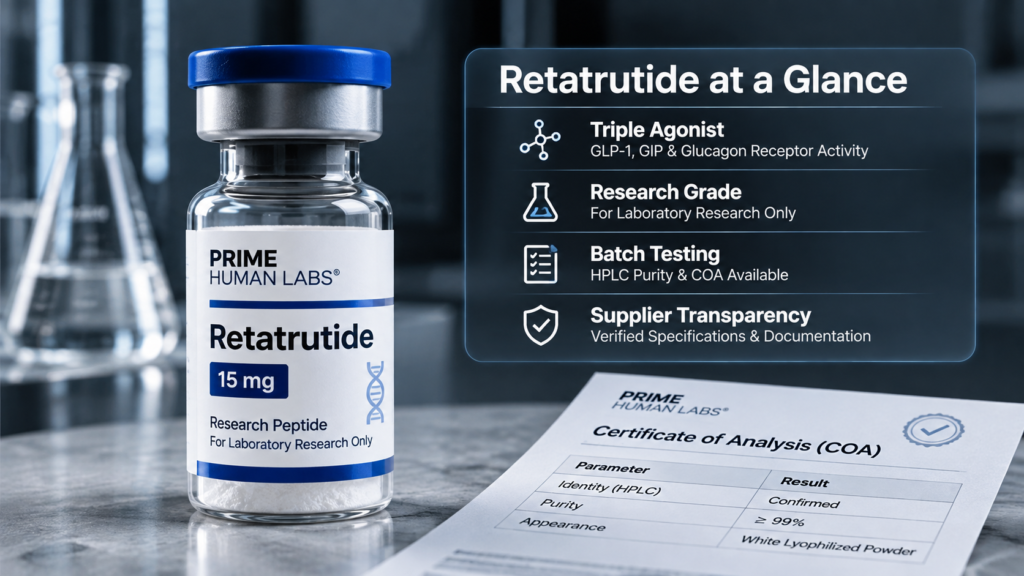
When evaluating research-labelled peptide materials, it is important to understand exactly what the documentation establishes.
Commonly referenced analytical and quality parameters include:
1. Molecular identity
Identity testing helps establish whether the analysed material is consistent with the intended molecule.
Mass spectrometry is one analytical method used to support molecular identity assessment.
2. HPLC purity
High-performance liquid chromatography (HPLC) separates components within a sample and can be used to assess chromatographic purity.
A reported HPLC purity percentage should always be interpreted alongside the analytical method, chromatogram and batch documentation.
Importantly, HPLC purity alone does not establish sterility, endotoxin status, biological activity or suitability for human administration.
3. Certificate of Analysis
A Certificate of Analysis (COA) records specified analytical results for a particular sample or batch.
A useful COA should identify:
- The product or material tested
- Batch or lot identification
- Analytical methods
- Reported test results
- Testing date
- Laboratory identification
Documentation should be authentic and independently verifiable where possible.
4. Batch traceability
Batch traceability connects a material to its manufacturing and testing documentation.
It is an important consideration for laboratory quality systems and research recordkeeping.
What Additional Quality Tests Should Researchers Understand?
HPLC is only one part of analytical quality assessment. Different testing methods are used to evaluate different characteristics of research materials.
Some additional methods include:
- Mass spectrometry: Helps support molecular identity by analysing molecular mass.
- Peptide mapping: Can provide additional information about peptide sequence and structure.
- Sterility testing: Evaluates microbial contamination using specified testing procedures.
- Endotoxin testing: Evaluates bacterial endotoxin levels using an appropriate analytical method.
These tests address different quality attributes and should not be treated as interchangeable.
For example, a high HPLC purity result does not automatically demonstrate sterility or low endotoxin levels. Researchers should examine the actual test reports and methods rather than relying on a single headline purity percentage.
Retatrutide India: Understanding Supplier Documentation
When evaluating Retatrutide India research information, examine product specifications, batch-specific analytical reports and independently verifiable documentation.
When researching Retatrutide India, it is important to distinguish between product descriptions, analytical documentation and independently verifiable laboratory results.
Online searches for Retatrutide India may return a mixture of research suppliers, overseas websites and commercial listings.
A product listing by itself does not establish quality or regulatory compliance.
When reviewing supplier documentation for legitimate laboratory research, examine:
- Whether batch identification is available
- Whether analytical documentation is specific to the batch
- Whether testing methods are disclosed
- Whether the laboratory can be identified
- Whether claims can be independently verified
- Whether applicable regulatory requirements are addressed
Be cautious of unsupported claims such as guaranteed purity, pharmaceutical-grade quality or clinical suitability without appropriate evidence.
How to Evaluate Laboratory Documentation
When examining research material documentation, it is useful to distinguish between a product specification sheet and a batch-specific analytical report.
A specification sheet describes the stated characteristics of a material, while a batch-specific report records the results of testing performed on an identified sample.
Researchers should examine whether:
- The batch number matches the material being documented.
- The analytical report identifies the testing method.
- The reported results include appropriate supporting information.
- The testing laboratory can be identified.
- The report date and sample identification are clear.
This helps establish documentation traceability and makes it easier to assess whether quality claims are supported by actual analytical evidence.
Prime Human Labs: Retatrutide Product Information
Prime Human Labs maintains a product information page for its retatrutide-labelled research material.
The page provides the product listing and associated specifications and documentation information.
View the product information:
https://primehumanlabs.com/products/retatrutide-india/
Readers should review the actual product documentation rather than relying solely on headline claims or promotional descriptions.
Any analytical result should be assessed in the context of its specific batch, method and laboratory report. Research-labelled material must not be represented as an approved medicine.
Understanding Product Specifications and Documentation
When reviewing a research-labelled product listing, readers should distinguish between the information presented on the product page and the analytical evidence available for the relevant batch.
Product descriptions can communicate the material’s stated identity and specifications. However, laboratory reports are needed to substantiate analytical claims.
For example, an HPLC purity statement should be considered alongside its corresponding analytical method and report. Similarly, a reference to a Certificate of Analysis should be supported by an identifiable document.
Transparent documentation is important for evaluating research materials and understanding the limitations of available quality information.
Is Retatrutide Approved in India?
This is one of the most important questions surrounding Retatrutide India searches.
As of November 21, 2026, retatrutide remains an investigational medicine and has not received marketing approval from a regulatory agency.
India has authorised clinical trial activity involving retatrutide. However, permission to conduct a clinical trial is not equivalent to approval for commercial marketing or general human use.
For current information, consult:
- Central Drugs Standard Control Organisation (CDSCO)
- ClinicalTrials.gov
- Eli Lilly’s official research announcements
- Peer-reviewed clinical publications
Regulatory status can change, so readers should verify the latest official records.
Clinical Trial Permission vs Commercial Approval
One important distinction in the Indian regulatory landscape is the difference between permission to conduct a clinical trial and approval to market a medicine.
Clinical trial permission allows research to proceed under specified regulatory conditions and an approved study protocol.
Marketing approval is a separate regulatory decision that involves evaluation of the relevant evidence and applicable requirements.
Therefore, the existence of an Indian clinical trial involving retatrutide should not be interpreted as general commercial approval.
Readers should consult CDSCO announcements and official regulatory records for the latest status.
Frequently Asked Questions
What is Reta India?
Reta is an informal abbreviation commonly used online for retatrutide. Retatrutide is the scientific name of the investigational molecule.
What is retatrutide’s development code?
Its development code is LY3437943.
What receptors does retatrutide target?
Retatrutide activates GIP, GLP-1 and glucagon receptors.
What is HPLC purity?
HPLC purity is a chromatographic measurement used to assess the relative proportion of components detected under a specified analytical method. It does not establish every aspect of material quality.
Does a COA prove a product is safe for human use?
No. A COA documents specified test results. It does not establish regulatory approval, clinical safety or suitability for human administration.
Is retatrutide approved in India?
Retatrutide remains investigational as of November 21, 2026. Clinical trial permission should not be confused with marketing approval.
Conclusion
For readers researching Retatrutide India, transparent documentation and reliable scientific references are essential when evaluating available information.
Reliable information about Retatrutide India should prioritise scientific evidence, transparent documentation and accurate regulatory information.
Retatrutide is an important subject in metabolic research because of its triple hormone receptor activity and ongoing clinical development.
For anyone researching Retatrutide India, the most useful approach is to understand the scientific evidence, examine analytical documentation carefully and distinguish research activity from regulatory approval.
Reliable scientific information should always take priority over unsupported commercial claims.
Research and regulatory disclaimer: This article is for educational purposes only. Retatrutide is investigational and is not approved for general human use. It is not a recommendation to obtain, administer or use retatrutide.
Scientific References & Further Reading
For readers interested in the scientific research and regulatory development of retatrutide, the following sources provide additional information:
- Eli Lilly – What to Know About Retatrutide
Official information about retatrutide’s mechanism, clinical development and investigational status.
https://www.lilly.com/news/stories/what-to-know-about-retatrutide - New England Journal of Medicine – Retatrutide, a Triple Hormone Receptor Agonist, for Treatment of Obesity
Peer-reviewed clinical research published in September 2026.
https://www.nejm.org/doi/10.1056/NEJMoa2604169 - ClinicalTrials.gov – Retatrutide Clinical Studies
Official registry of clinical trials involving retatrutide.
https://clinicaltrials.gov/search?term=retatrutide - CDSCO – Government of India Clinical Trial Permission
Official documentation concerning an authorised Phase 3 retatrutide clinical trial in India.
https://www.cdsco.gov.in/opencms/resources/UploadCDSCOWeb/2018/UploadCTApprovals/%2895%29-42430-EliLilly-CTNOC.pdf - CDSCO – Official Regulatory Portal
Government portal for Indian drug and clinical trial regulatory information.
https://cdscoonline.gov.in/CDSCO/homepage
Note: Clinical trial authorisation is not equivalent to marketing approval. Retatrutide remains investigational and is not approved for general human use.