

Choosing a peptide supplier in India requires more than comparing product prices or browsing online catalogues. Researchers should evaluate supplier transparency, batch-specific documentation, analytical testing, product traceability and applicable regulatory requirements.
In this guide, we examine Prime Human Labs as an India-focused research peptide supplier and explain the criteria that should be used when independently evaluating other domestic and international suppliers.
Rather than presenting an unverified ranking, we focus on the information researchers should examine before assessing any supplier.
We’ll also look at Prime Human Labs and its research peptide product range.

Table of Contents
What Are Peptides? Understanding Peptide Research in India
Peptides are short chains of amino acids connected through peptide bonds. They play important roles in biological processes and are studied extensively in fields such as biochemistry, molecular biology and pharmaceutical research.
Different peptides have different structures and biological activities.
Some commonly discussed research peptides include:
- Retatrutide: An investigational triple hormone receptor agonist being studied for metabolic and obesity-related conditions.
- BPC-157: A synthetic peptide investigated in preclinical research.
- TB-500: A peptide-related compound associated with research into cellular processes.
- GHK-Cu: A copper-binding peptide studied in skin biology and tissue-related research.
- CJC-1295: A synthetic growth hormone-releasing hormone analogue.
- Ipamorelin: A synthetic growth hormone secretagogue studied in endocrinology research.
It is important to understand that research findings do not automatically establish safety or efficacy in humans. Research-grade products should not be treated as approved medicines or used for self-treatment.
Best Peptides India Brands to Know in 2027
When evaluating peptide brands in India, the most important factors should be transparency, product documentation, quality control and regulatory compliance.
Rather than relying exclusively on marketing claims, consumers and research institutions should evaluate the information each supplier makes available.
Here are some considerations and a featured India-based brand to investigate.
1. Prime Human Labs
Website: https://primehumanlabs.com/
Prime Human Labs is an India-focused brand specialising in research peptide products and related laboratory supplies.

The brand offers a range of peptide compounds across different research categories, including:
- Retatrutide
- BPC-157
- TB-500
- GHK-Cu
- CJC-1295 + Ipamorelin
- Tesamorelin
- IGF-1 LR3
- MOTS-C
- Klow Blend
- Bacteriostatic Water
One of the important considerations when evaluating Prime Human Labs is its stated emphasis on product documentation and Certificates of Analysis (COAs).
A COA can provide information about the tested sample, analytical methods, test results and laboratory identification. Buyers should verify that documentation is batch-specific and issued by a competent independent laboratory.
What to evaluate:
- Availability of product-specific COAs.
- Batch identification and traceability.
- Clear product specifications.
- Transparent sourcing information.
- Appropriate research-use labelling.
- Accessible customer support and documentation.
Prime Human Labs is one option to investigate when researching peptide suppliers in India. Its quality claims should be assessed against the actual batch documentation rather than marketing descriptions alone.
Website: https://primehumanlabs.com/
2. International Peptide Suppliers
Several international suppliers operate in the research peptide space and may be considered by researchers looking for specialised compounds.
However, international availability does not automatically establish product quality, regulatory compliance or suitability for use in India.
Before evaluating an overseas supplier, consider:
- Whether the supplier provides batch-specific analytical documentation.
- Whether the testing laboratory can be independently identified.
- Whether the product specifications are clearly disclosed.
- Whether importation and distribution comply with applicable Indian regulations.
- Whether the supplier provides appropriate documentation for institutional research.
International shipping and an imported-product label should never be treated as proof of quality.
3. Research Chemical and Laboratory Suppliers
Some suppliers focus on laboratory reagents, analytical materials and research chemicals rather than consumer-facing peptide brands.
These suppliers may serve specialised research requirements.
When comparing them, examine their documentation, analytical capabilities, product traceability and regulatory status.
A professional-looking website or a low advertised price is not sufficient evidence of product quality.
Important: This is an evaluation category, not an endorsement of any particular supplier. A supplier should only be included in a verified brand ranking after its identity, documentation and regulatory position have been independently checked.
How to Choose Reliable Peptide Suppliers in India
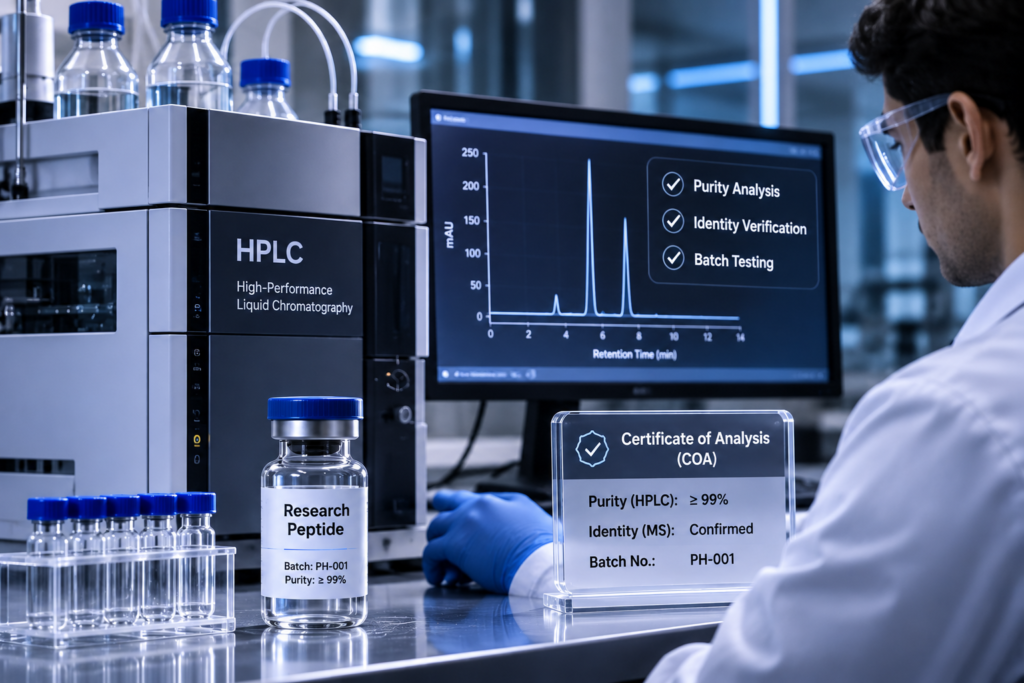
If you’re researching peptide suppliers in India, evaluating quality documentation should be a priority.
Here are five important factors.
1. Certificate of Analysis (COA)
A Certificate of Analysis is a laboratory document that reports the analytical results for a particular sample or batch.
Depending on the compound and testing method, it may contain:
- Product identification.
- Batch or lot number.
- Analytical test results.
- Purity-related measurements.
- Testing methodology.
- Laboratory details.
- Date of testing.
A COA should be traceable to the specific batch being evaluated. A generic certificate or an image without verifiable laboratory details should not be considered sufficient evidence.
2. Third-Party Laboratory Testing
Independent testing can provide additional information about product composition and quality.
However, it is important to understand what a test actually establishes.
For example, a purity result from HPLC does not independently establish sterility, endotoxin levels, biological activity or safety for human administration.
Different analytical tests answer different questions.
3. Product Transparency
A reliable supplier should provide clear information about its products.
Look for:
- Accurate compound names.
- Clearly stated specifications.
- Batch identification.
- Appropriate storage information.
- Product documentation.
- Clear research-use labelling.
Avoid relying on exaggerated claims such as guaranteed results or claims that a research compound has no side effects.
4. Sourcing and Traceability
Understanding where a product comes from is another important consideration.
A supplier should be able to explain its sourcing arrangements and provide appropriate supporting documentation.
Claims such as imported, pharmaceutical-grade or USA-sourced should be independently substantiated.
5. Regulatory Compliance
This is particularly important when researching peptides in India.
The Central Drugs Standard Control Organisation (CDSCO) oversees important aspects of drug approval, importation and regulation in India.
A product being advertised as research-grade does not automatically exempt its manufacture, import, stocking or sale from applicable regulations.
Always distinguish between laboratory research materials and medicines approved for human use.
Popular Research Peptides in India
Interest in several peptide compounds has increased in recent years.
Here is an overview of some frequently discussed compounds.
Retatrutide India: Understanding the Research
Retatrutide is one of the most discussed investigational compounds in the metabolic research space.
It is a triple hormone receptor agonist that targets GIP, GLP-1 and glucagon receptors.
Researchers are studying its potential role in metabolic and obesity-related conditions.
Search interest for Retatrutide India and related terms has increased as more information about clinical trials becomes available.
However, Retatrutide remains investigational as of this article’s November 2026 research cutoff. It is not an approved medicine for general human use. Products advertised online should not be confused with an authorised pharmaceutical formulation.
GHK-Cu India: What Is GHK-Cu?
GHK-Cu is a copper-binding tripeptide consisting of glycine, histidine and lysine associated with copper.
It has attracted scientific interest in areas including skin biology, wound-related research and cellular processes.
The keyword GHK-Cu India is increasingly relevant to people researching copper peptides and their scientific applications.
It is important to distinguish research-grade GHK-Cu from appropriately regulated cosmetic formulations containing copper peptides. Their regulatory status and intended applications can differ.
CJC-1295 + Ipamorelin India
CJC-1295 and Ipamorelin are two different synthetic peptides studied in relation to growth hormone signalling.
CJC-1295 is a growth hormone-releasing hormone analogue, while Ipamorelin is a growth hormone secretagogue.
The combination is frequently discussed in peptide research communities.
People searching for CJC IPA India should understand that scientific investigation of these compounds does not establish the safety or effectiveness of combining them in humans.
BPC-157 India
BPC-157 is a synthetic peptide that has attracted attention in preclinical research.
It is frequently discussed in connection with tissue-related biological processes.
However, much of the available evidence is preclinical, and its safety and efficacy in humans have not been established through adequate clinical evidence.
TB-500 India
TB-500 is another compound discussed in experimental peptide research.
It is associated with research interest in thymosin beta-related biology.
As with other experimental compounds, laboratory findings should not be interpreted as proof of human therapeutic benefits.
Why Are People Searching for Peptides in India?
There are several reasons behind the growing interest in peptides.
1. Increased access to scientific information
More people are exploring biotechnology, molecular biology and pharmaceutical research through online educational resources.
2. Growing interest in peptide science
Peptides have become an increasingly discussed topic across scientific and biotechnology communities.
3. Availability of online suppliers
The internet has made it easier to discover international and domestic research material suppliers.
4. Increased awareness of laboratory testing
More buyers are asking about purity testing, batch documentation and Certificates of Analysis rather than relying exclusively on product descriptions.
However, increased online availability does not mean that every product is genuine, properly tested or legally authorised.
Buy Peptides in India: What Should You Know?
People searching for buy peptides in India will encounter a wide variety of websites and product listings.
Before engaging with any supplier, consider the following:
- Check the supplier’s identity and business information.
- Review the actual product documentation.
- Verify batch-specific laboratory reports.
- Understand the difference between purity testing and safety testing.
- Check the applicable regulatory requirements for the specific compound and intended purpose.
- Avoid websites making guaranteed medical or physical transformation claims.
A research-use disclaimer alone does not establish that a product or its sale complies with Indian law.
For products intended for medical treatment, consult a qualified healthcare professional and use appropriately authorised medicines through lawful channels.

Frequently Asked Questions About Peptides in India
1. Which are the best peptide brands in India in 2027?
There is no independently established universal ranking of peptide brands in India. When evaluating a supplier, consider batch-specific COAs, independent laboratory testing, product traceability, sourcing transparency and regulatory compliance.
Prime Human Labs is one India-focused brand that can be investigated through its published product information and documentation.
2. Where can I find information about peptides in India?
You can research peptide suppliers through their official websites, product specifications, scientific publications and relevant regulatory databases.
Prime Human Labs (primehumanlabs.com) provides information about its research peptide product range and associated documentation.
3. What is Retatrutide India?
Retatrutide is an investigational triple hormone receptor agonist targeting GIP, GLP-1 and glucagon receptors. It is being studied in clinical trials, but it is not approved for general human use as of November 2026.
4. What is GHK-Cu?
GHK-Cu is a copper-binding peptide studied for its potential involvement in skin biology and other cellular processes. Research-grade material should be distinguished from regulated cosmetic formulations.
5. What does CJC IPA stand for?
CJC IPA generally refers to the combination of CJC-1295 and Ipamorelin. These are separate synthetic peptides studied in relation to growth hormone signalling.
6. Are research peptides approved for human use in India?
Research-grade labelling does not mean that a compound has been approved for human use. Approval and regulatory requirements depend on the specific substance, formulation, intended use and applicable Indian laws.
7. Why is a Certificate of Analysis important?
A COA provides analytical information about a tested sample. It can help establish product identity and certain quality characteristics, provided the document is genuine, traceable and relevant to the batch in question.
Final Thoughts on Buying Peptides in India
The peptide industry in India is attracting increasing attention, but the availability of products online should not be confused with verified quality or regulatory approval.
Whether researching Retatrutide, GHK-Cu, CJC-1295 + Ipamorelin, BPC-157 or TB-500, documentation and transparency should remain central to any supplier evaluation.
Prime Human Labs is an India-focused research peptide brand worth investigating as part of this evaluation. Its product documentation, batch-specific testing information and sourcing transparency should be reviewed before drawing conclusions about product quality.
As the industry evolves in 2027, informed research, scientific accuracy and regulatory awareness will be more important than ever.
Explore Prime Human Labs: https://primehumanlabs.com/
About This Article
Published by: Prime Human Labs Editorial Team
Last updated: November 2026
This article is intended to provide educational information about peptide science, research materials, laboratory testing and supplier evaluation in India.
Scientific and regulatory information should be checked against the latest published research and official regulatory sources.
Scientific References & Further Reading
Readers interested in learning more about peptide science, analytical testing and pharmaceutical regulations can explore these resources:
- National Center for Biotechnology Information (NCBI) – Scientific literature and biomedical research.
- PubMed Central – Regulatory Guidelines for the Analysis of Therapeutic Peptides and Proteins – Scientific review of peptide analytical methods and quality assessment.
- Springer – Regulatory and Analytical Considerations for the Quality Assessment of Peptide Drugs (2026) – Research on peptide identity, purity and analytical characterization.
- CDSCO India – Official Indian drug regulatory information.
Disclaimer: This article is for general educational and informational purposes only. Research-grade compounds are not necessarily approved medicines. Nothing in this article constitutes medical advice, a recommendation to purchase or administer research compounds, or a claim that any product is safe or effective for human use. Always consult applicable regulatory requirements and qualified professionals.