
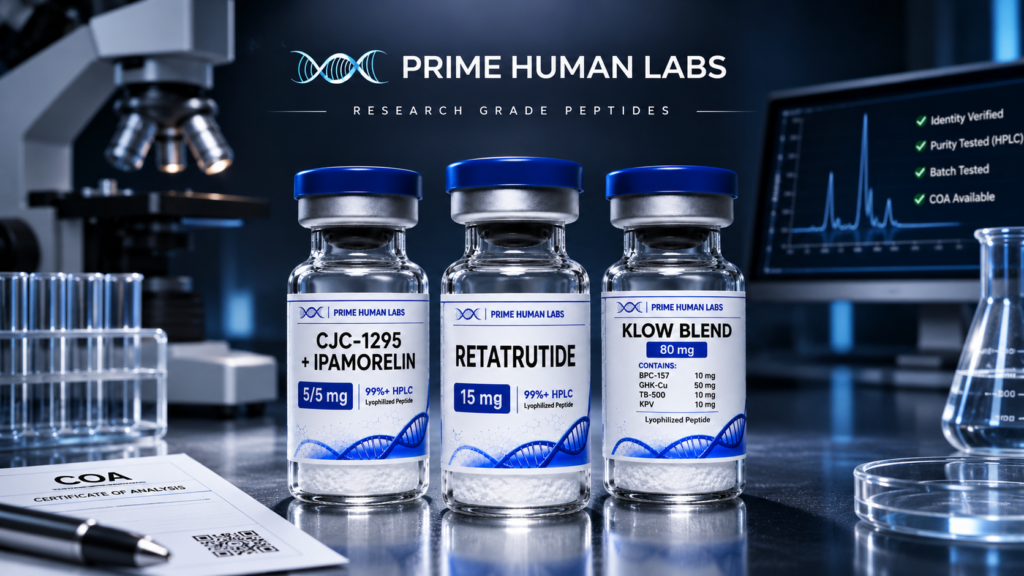
Before you buy, understand what you’re buying.
A product label, a purity percentage or a certificate does not automatically establish the quality, identity or safety of a peptide.
The Indian peptide market has attracted growing interest in compounds such as BPC-157, GHK-Cu, TB-500, CJC-1295, Ipamorelin and other synthetic peptides.
But there is a question that deserves more attention than the latest peptide trend:
How do you actually know what’s inside the vial you’re looking at?
Two products carrying the same peptide name can have very different manufacturing histories, analytical documentation and quality characteristics.
If you’re researching peptides in India, this guide will help you understand the science behind peptide testing, how to evaluate laboratory reports, and what questions to ask before trusting a supplier.
In this guide:
- Peptide quality and purity
- HPLC and mass spectrometry
- Certificate of Analysis (COA)
- Third-party laboratory testing
- Common quality concerns
- Storage and stability
- Indian regulatory considerations
- A practical supplier evaluation checklist
Disclosure: This publication is affiliated with Prime Human Labs. Prime Human Labs has a commercial interest in the peptide industry. This article is educational and is not an independent supplier comparison or medical recommendation.
01. Understanding the Peptide Market in India
Peptides are short chains of amino acids connected by peptide bonds. They have important roles in biological processes and are studied across several areas of pharmaceutical and biomedical research.
However, the word peptide describes a broad category of molecules, not a single type of product.
Some peptides are approved medicines for specific indications. Others are investigational compounds, laboratory research materials or substances without established clinical applications.
A compound appearing in a scientific publication does not automatically mean that:
- It is approved for human use.
- Its safety has been established.
- Its effectiveness has been demonstrated in clinical trials.
- Every commercially available version meets pharmaceutical quality standards.
Why product documentation matters
A supplier should be able to explain the origin and documentation associated with its products.
Consider these questions:
- Who manufactured the material?
- Is the batch identifiable?
- Is there analytical documentation for that specific batch?
- Which laboratory performed the testing?
- What analytical methods were used?
- What exactly do the test results establish?
A product description is not a substitute for analytical evidence.
02. Peptide Purity: Why the Percentage Isn’t Everything
One of the most commonly advertised specifications in the peptide market is purity.
You might encounter descriptions such as:
| Advertised purity | What it tells you |
|---|---|
| 95% | A reported analytical purity result |
| 98% | A higher reported analytical purity result |
| 99% | A very high reported analytical purity result |
At first glance, a higher percentage might appear to indicate a better product.
But there is an important scientific distinction between chromatographic purity, actual peptide content and overall product quality.
What is peptide purity?
Synthetic peptides can contain different types of impurities arising during manufacturing, purification, handling and storage.
These may include:
- Incomplete synthesis products.
- Truncated peptide sequences.
- Deletion sequences.
- Oxidation products.
- Degradation products.
- Residual solvents and other process-related impurities.
The presence and significance of these impurities depend on the molecule, manufacturing process and analytical method.
Does 99% HPLC purity mean 99% peptide content?
No.
An HPLC purity result generally represents the relative chromatographic signal assigned to the main peak compared with other detected peaks under specified analytical conditions.
It does not necessarily establish the actual mass or quantity of peptide in the vial.
A chromatogram showing a dominant main peak does not independently establish:
- Actual peptide content.
- Absence of substances the method cannot detect.
- Sterility.
- Endotoxin levels.
- Biological activity.
- Suitability for human administration.
A more complete quality assessment may require additional analytical procedures.
Scientific reference: Sharma et al. (2022), Synthetic Pharmaceutical Peptides Characterization by Chromatography Principles and Method Development.
Read the scientific paper – DOI: 10.1002/jssc.202101034
03. HPLC Testing: What Does It Actually Tell You?
<blockquote>
HPLC stands for High-Performance Liquid Chromatography. It is an analytical technique widely used in pharmaceutical research and manufacturing to separate and evaluate components within a sample.
</blockquote>
For synthetic peptides, reversed-phase HPLC is commonly used to assess chromatographic purity and peptide-related impurities.
How does HPLC work?
In simplified terms:
- A prepared sample is introduced into the analytical system.
- The sample passes through a chromatographic column.
- Different components interact differently with the column.
- The components separate over time.
- A detector records signals, producing a chromatogram.
The chromatogram contains peaks corresponding to detected components.
A dominant peak may represent the principal peptide component, but additional identification work is needed to establish which compound each peak represents.
What should you look for in an HPLC report?
| Parameter | Why it matters |
|---|---|
| Sample identification | Identifies the material tested |
| Batch number | Connects the report to a particular batch |
| Analytical method | Explains how testing was performed |
| Retention time | Helps characterize chromatographic behaviour |
| Main peak | Identifies the principal detected component |
| Impurity profile | Shows additional detected components |
| Purity calculation | Explains the reported chromatographic result |
| Laboratory details | Helps establish report traceability |
Remember: A screenshot displaying only a purity percentage is much less informative than a complete analytical report.
04. Mass Spectrometry: Confirming Molecular Identity
Another important analytical technique is mass spectrometry (MS).
While HPLC helps separate components, mass spectrometry provides information about the mass-to-charge ratio of detected ions.
This information can help assess whether the detected material has the expected molecular mass.
For synthetic peptides, mass spectrometry is particularly useful for identifying the intended molecular product and detecting certain molecular impurities.
HPLC vs Mass Spectrometry
| Parameter | HPLC | Mass Spectrometry |
|---|---|---|
| Main purpose | Separation and chromatographic purity assessment | Molecular mass and structural characterization |
| Impurity assessment | Yes, within method limitations | Helps characterize molecular impurities |
| Molecular mass | Not directly established by a standard chromatogram | Yes |
| Sequence information | Limited | MS/MS can provide sequence information |
| Complete quality assessment | No | No |
Why combining both methods matters
Imagine a sample produces a major HPLC peak.
That alone does not conclusively establish that the peak corresponds to the intended peptide.
Mass spectrometry can provide additional evidence about molecular identity.
For more detailed characterization, tandem mass spectrometry (MS/MS) can provide information about amino acid sequence and structural differences.
However, even mass spectrometry has limitations. Certain structural differences, including some isomers, may require additional analytical techniques.
Scientific reference:
Lian et al. (2021), Characterization of Synthetic Peptide Therapeutics Using Liquid Chromatography–Mass Spectrometry: Challenges, Solutions, Pitfalls, and Future Perspectives.
Read the scientific paper – DOI: 10.1021/jasms.0c00479
05. Certificate of Analysis (COA): What Should You Actually Check?
A Certificate of Analysis is one of the most frequently requested documents in the peptide industry.
But simply receiving a PDF labelled COA should not end your verification process.
A COA is only as useful as the testing, traceability and information behind it.
What should a COA contain?
01 — Product identification
Does the document clearly identify the tested material?
Check the product name, identifier and relevant molecular information.
02 — Batch or lot number
The batch number should correspond to the material being documented.
A generic report without batch traceability is less useful for evaluating a specific product.
03 — Testing laboratory
Look for the laboratory’s name and contact information.
If the report claims independent testing, check whether the laboratory can independently confirm the report.
04 — Analytical methods
Look for the methods used to evaluate the sample.
Examples include HPLC, LC-MS and LC-MS/MS, depending on the quality attribute being evaluated.
05 — Actual results
A useful report should provide actual analytical results rather than simply stating “Passed.”
06 — Dates and report identification
Check the test date, report number and sample identification.
Can you verify a COA online?
Where available, use the laboratory’s official verification system or contact the laboratory directly through independently obtained contact details.
Compare:
- Report number.
- Batch number.
- Product identity.
- Testing date.
- Reported analytical results.
Be cautious about documents that cannot be independently authenticated.
Does a COA guarantee that a peptide is safe?
No.
A COA documenting chromatographic purity and molecular identity does not automatically establish sterility, absence of endotoxins, clinical safety, human-use suitability or therapeutic effectiveness.
Different quality attributes require different tests.
A laboratory report must always be interpreted in the context of what was actually tested.
06. Third-Party Laboratory Testing: Why Does It Matter?
A manufacturer or supplier may perform internal quality checks.
However, independent laboratory testing can provide an additional layer of analytical oversight.
Third-party testing is particularly useful when the laboratory’s independence, sample handling and reporting processes are transparent.
What makes third-party testing meaningful?
Consider these questions:
- Is the laboratory identifiable?
- Does it have appropriate analytical capabilities?
- Is its accreditation relevant to the tests being performed?
- Can the report be authenticated?
- Is the tested sample traceable to a particular batch?
- Are the analytical methods and results disclosed?
An ISO/IEC 17025 accreditation, for example, can be relevant when assessing laboratory competence.
However, accreditation must be checked against the laboratory’s actual scope of accreditation.
Different tests evaluate different attributes
| Analytical technique | What it can help assess |
|---|---|
| HPLC | Chromatographic purity and impurities |
| LC-MS | Molecular mass and impurity characterization |
| LC-MS/MS | More detailed molecular and sequence information |
| Amino acid analysis | Amino acid composition or peptide content, depending on method |
| Endotoxin testing | Endotoxin levels |
| Microbiological testing | Microbial contamination |
| Sterility testing | Whether specified sterility criteria are met |
Not every test is applicable to every product or purpose.
The key is to understand what each report establishes rather than treating a single certificate as proof of complete quality.
07. Common Peptide Quality Concerns
Peptide manufacturing and handling involve multiple stages, and quality problems can arise at different points.
Here are some of the major considerations.
A. Incorrect molecular identity
A product label may identify a particular peptide, but the material needs appropriate analytical characterization to support that identity.
B. Manufacturing impurities
Synthetic peptide production can generate incomplete sequences, deletion products and other impurities.
The extent and significance of these impurities depend on the manufacturing and purification process.
C. Degradation
Peptides can undergo chemical or physical changes during storage and handling.
Depending on the molecule and conditions, degradation may involve oxidation, hydrolysis, aggregation or other changes.
D. Batch-to-batch variation
Different manufacturing batches may have different analytical characteristics.
This is why batch-specific documentation is more meaningful than repeatedly displaying an old or generic certificate.
E. Inadequate documentation
A supplier that cannot explain the origin, testing methods or batch identity of a product leaves important quality questions unanswered.
F. Microbiological contamination
Chemical purity and microbiological quality are separate considerations.
A high chromatographic purity result cannot establish that a material is sterile or free from endotoxins.
This distinction is especially important because products intended for laboratory research should not be assumed suitable for administration to humans.
08. Understanding Peptide Storage and Stability
Peptide stability is another important part of quality assessment.
Different peptides have different physicochemical characteristics, and their stability depends on several factors.
These may include:
- Temperature.
- Moisture.
- Light exposure.
- pH.
- Formulation.
- Container characteristics.
- Storage duration.
- Handling conditions.
Lyophilization (freeze-drying) is used for many peptide formulations, but it does not make every peptide indefinitely stable.
Stability must be established for the particular molecule and formulation using appropriate studies.
A generic storage recommendation should not be treated as proof of a product’s shelf life.
Scientific reference:
McCarthy et al. (2023), Reference Standards to Support Quality of Synthetic Peptide Therapeutics.
Read the full open-access scientific paper
09. What Is the Regulatory Situation for Peptides in India?
This is an area where consumers should be particularly careful.
India regulates drugs under the Drugs and Cosmetics Act, 1940 and associated rules, including the Drugs Rules, 1945 and the New Drugs and Clinical Trials Rules, 2019.
The Central Drugs Standard Control Organization (CDSCO) oversees important aspects of drug regulation, including new-drug approvals and import-related regulatory functions.
Official regulatory resources
Does a research-use-only label make every product legally unrestricted?
No.
The regulatory classification of a substance depends on its characteristics, intended use, claims, presentation and applicable law.
A “research use only” disclaimer does not automatically exempt a product from applicable regulatory requirements.
Similarly, a product being available online does not establish that its import, manufacture, distribution or sale is lawful.
The regulatory status of each substance and product must be assessed individually.
Consumers should not assume that an investigational peptide is an approved medicine or that it is suitable for self-administration.
For product-specific questions, consult a qualified Indian regulatory professional or healthcare professional as appropriate.
10. Questions Worth Asking Before Trusting a Peptide Supplier
Before relying on a supplier’s claims, consider asking the following questions.
Manufacturing and origin
- Can you identify the manufacturer?
- Is the manufacturing origin documented?
- Can you provide traceability information for the batch?
Testing and documentation
- Is there a batch-specific COA?
- Which laboratory performed the testing?
- Can the report be independently verified?
- Was HPLC used?
- Was molecular identity assessed using mass spectrometry?
- What exactly does the reported purity percentage represent?
- Are additional quality attributes documented where relevant?
Business and regulatory transparency
- Is the business identity transparent?
- Can the supplier explain the regulatory status of the product?
- Are product claims supported by appropriate evidence?
- Is there a clear way to contact the business?
These questions are not a guarantee of product safety or legal compliance. They are a starting point for evaluating the quality of information a supplier provides.
11. Where Does Prime Human Labs Fit Into This?
At Prime Human Labs, we believe that scientific transparency and product documentation deserve more attention in the peptide industry.
Rather than asking people to rely solely on product descriptions or marketing claims, we believe they should understand the importance of analytical methods, batch identification and verifiable documentation.
Explore Prime Human Labs:
Visit Prime Human Labs – Official Website
For readers researching peptide-related laboratory documentation, the important questions remain the same:
- What was tested?
- Which batch was tested?
- Which analytical method was used?
- Who performed the test?
- Can the results be independently verified?
We encourage readers to evaluate these details rather than relying on marketing language alone.
Prime Human Labs’ commercial interests should also be considered when evaluating any information published by or affiliated with the company.
No product should be assumed clinically safe, effective, approved or suitable for human administration merely because analytical documentation is available.
12. Final Verdict: Don’t Evaluate Peptides by the Label Alone
The peptide market is scientifically complex, and understanding product quality requires more than reading a product description.
A high purity percentage does not establish every aspect of quality.
An HPLC report does not independently confirm molecular identity.
A mass spectrometry result does not establish sterility.
A COA does not establish clinical safety.
And a product appearing on a website does not automatically mean it has regulatory approval.
If there is one thing worth remembering before researching any peptide supplier in India, it is this:
Look beyond the label. Understand the testing. Verify the documentation. Question unsupported claims.
Scientific transparency should be a basic expectation, not a marketing advantage.
Frequently Asked Questions
1. How can I check the quality of peptides in India?
Start by examining batch-specific documentation, the identity of the testing laboratory, analytical methods and actual test results. HPLC and mass spectrometry can provide complementary information, but neither alone establishes every aspect of product quality or clinical safety.
2. What is a COA in the peptide industry?
A Certificate of Analysis is a document reporting analytical results for a particular sample or batch. Its usefulness depends on the testing methods, sample traceability, laboratory credibility and the quality attributes actually evaluated.
3. Is 99% peptide purity good?
A 99% chromatographic purity result may indicate a dominant main peak under the specified analytical conditions. However, it does not necessarily mean 99% actual peptide content, nor does it establish sterility, endotoxin levels or suitability for human use.
4. What is the difference between HPLC and mass spectrometry?
HPLC separates components and can assess chromatographic purity. Mass spectrometry provides molecular mass information and, with tandem MS, can provide more detailed structural and sequence information. They serve complementary analytical purposes.
5. Does third-party peptide testing guarantee safety?
No. Independent testing can provide valuable evidence about specified quality attributes. However, the scope of testing matters. Purity and identity testing do not automatically establish sterility, clinical safety or effectiveness.
6. Are research peptides approved for human use in India?
Research-use-only materials should not be assumed to be approved medicines. Approval and regulatory requirements depend on the specific substance, formulation, intended use and applicable Indian regulations.
7. Why is batch-specific peptide testing important?
A batch-specific report links analytical results to an identifiable sample or manufacturing batch. A generic or outdated report may not establish the characteristics of the material currently being offered.
8. Can a peptide be pure but still contain contaminants?
Yes. A chromatographic purity result measures what the analytical method detects and reports. Other contaminants or quality attributes may require separate analytical procedures.
9. Why does peptide stability matter?
Peptides can undergo chemical or physical changes during storage. Stability depends on the molecule, formulation, environment and duration. Appropriate stability studies are needed to support shelf-life claims.
10. Where can I learn more about peptide research?
Start with peer-reviewed scientific literature, PubMed and official regulatory resources such as CDSCO. For general company and documentation information, visit Prime Human Labs.
Scientific References
The following peer-reviewed publications support the analytical and scientific discussions in this article.
01. Synthetic Pharmaceutical Peptides Characterization by Chromatography Principles and Method Development (2022)
Sharma N. et al. Journal of Separation Science.
Read publication – DOI: 10.1002/jssc.202101034
02. Characterization of Synthetic Peptide Therapeutics Using Liquid Chromatography–Mass Spectrometry (2021)
Lian Z. et al. Journal of the American Society for Mass Spectrometry.
Read publication – DOI: 10.1021/jasms.0c00479
03. Reference Standards to Support Quality of Synthetic Peptide Therapeutics (2023)
McCarthy D. et al. Pharmaceutical Research.
Read full open-access publication
04. Recommendations for the Generation, Quantification, Storage and Handling of Peptides Used for Mass Spectrometry-Based Assays (2016)
Read publication – PubMed Central
05. CDSCO – Import and Registration
Government of India.
Editorial Information
- Published: November 2026
- Last reviewed: November 2026
- Category: Peptides India
- Content type: Scientific research and consumer awareness
- Commercial disclosure: Published by a publication affiliated with Prime Human Labs.
- Medical disclaimer: This article is educational and is not medical advice, a prescription or a recommendation to purchase or administer research compounds. Consult a qualified healthcare professional for medical decisions.